How to Tell If a Tree Is Dead or Dying (Before It Tells You the Hard Way)
You Don't Need to Be an Expert to Spot a Dying Tree
Here's something I tell homeowners all the time: you don't have to know everything about trees to know when one of yours doesn't look right. Most people can sense it. The leaves came in thin this year. That one section always looks rough. There's something growing on the trunk that wasn't there before.
The problem is that most folks don't know what to do with that feeling. They figure maybe it's just having a bad season, or maybe it'll bounce back on its own. Sometimes it does. A lot of times it doesn't — and a dead or dying tree doesn't get safer with time.
Here's a simple ground-level inspection you can do yourself. No ladders, no climbing. Just your eyes and a few minutes.
If you're already past the inspection stage, learn more about dead tree removal Greensboro NC.
Step 1: Start at the Bark and Work Your Way Up
Stand close to the tree and really look at the bark. Healthy bark is firm, attached, and generally consistent in texture and color. What you don't want to see is bark peeling away in large sheets, big sections that are missing entirely, or dark discoloration that runs beneath the surface.
Scratch a small patch of bark near the base of the trunk with your fingernail. If what's underneath is green and damp, you're looking at living wood. If it's brown and papery dry, that section of the tree is dead. Do this in two or three different spots — sometimes a tree is dying in some areas and still hanging on in others.
Step 2: Look at the Canopy — Really Look
Now step back and look up. During spring and summer, a healthy tree should have a full, even canopy. Gaps, sections with no leaves, or branches that look gray and brittle while everything else is green — these are real warning signs.
Pay attention to something called flag branching. That's when one or two branches are fully leafed out but the rest of the tree is bare or sparse. It usually means the tree is struggling and pushing its remaining energy into just a few areas. That's not a good sign. That's a tree trying to hold on.
Step 3: Check for Fungal Growth and Soft Spots
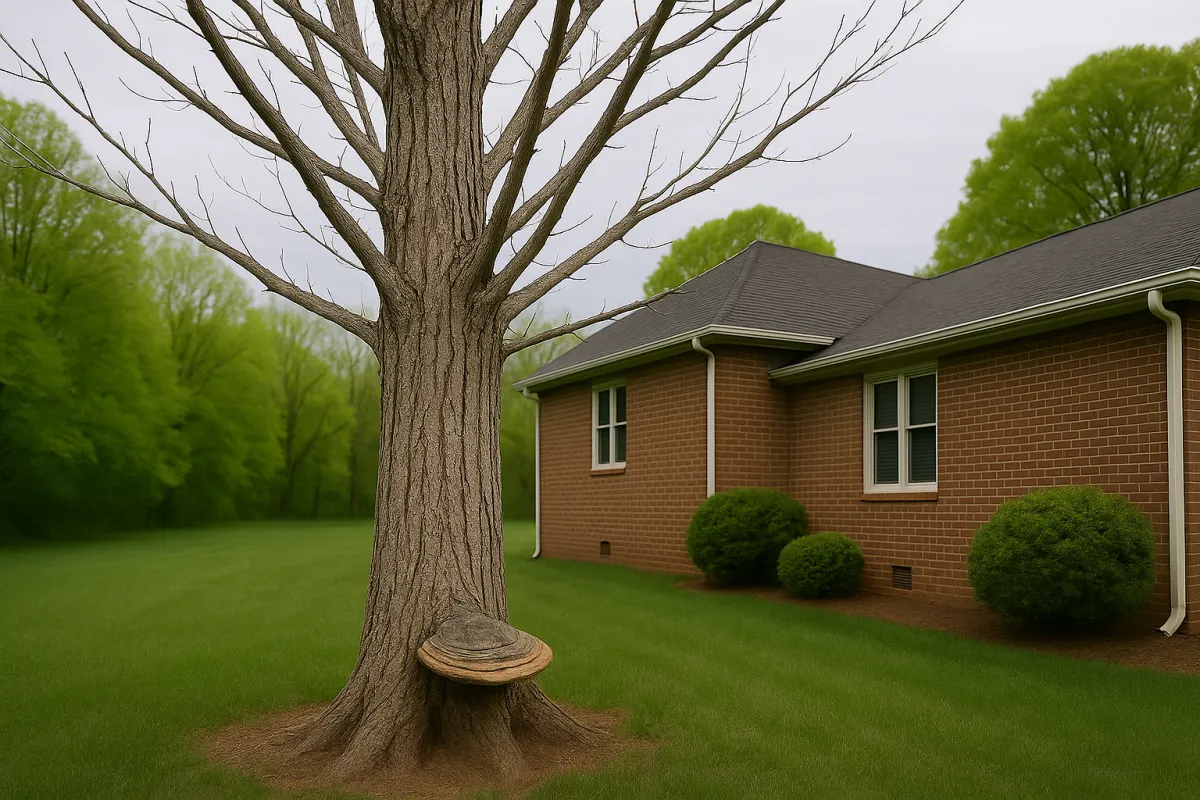
This one surprises a lot of people. If you see mushrooms growing at the base of a tree, or those thick flat shelf-like growths coming out of the trunk — those are called conks — don't dismiss them. Fungal growth almost always means internal wood decay. The tree may look fine on the outside while being soft and rotted at the core.
Press your thumb firmly against the base of the trunk in a few spots. Solid wood should feel solid. If it gives at all — if it feels spongy or soft — that's internal decay, and that tree is a safety concern.
Step 4: Get Down and Look at the Ground Around the Base
The soil directly around the base of a tree can tell you a lot. Look for soil that's heaved up or cracked away from the trunk — that can indicate root movement or failure. Look for any signs of construction damage in the area: old trenches, paving that was put in nearby, compacted soil from equipment. All of these can damage a tree's root system years before it shows up in the canopy.
In North Carolina, also keep an eye out for the signs of bark beetles — small round holes in the bark, or a fine sawdust-like material at the base of the tree. Pine trees in the Triad are especially vulnerable, particularly after a dry summer.
When the Inspection Stops Being Enough
A ground inspection gives you a starting point. But it's not the whole picture. If you're finding two or more of these warning signs on the same tree — especially a large one near your home or over any structure — don't try to make that call yourself. What you can see from the ground is only a fraction of what's actually going on with a tree.
A professional can assess root structure, check for internal cavities, and give you an honest read on whether the tree needs to come down, needs trimming, or just needs to be watched. That conversation is almost always worth having sooner than later.
Schedule a tree assessment High Point NC with our team to get a professional read on your trees.
Get a Professional Tree Assessment Today
If your inspection turned up some red flags, don't sit on it.
C Tree Removal Services offers professional tree assessments across Greensboro, Winston-Salem, High Point, and the surrounding Triad communities. We'll give you a straight answer on what you're dealing with.
Reach out today and let us take a look before a small problem becomes a big one.